-
 You Are Welcome HereBackForwardPauseCaption
-
Welcome
-
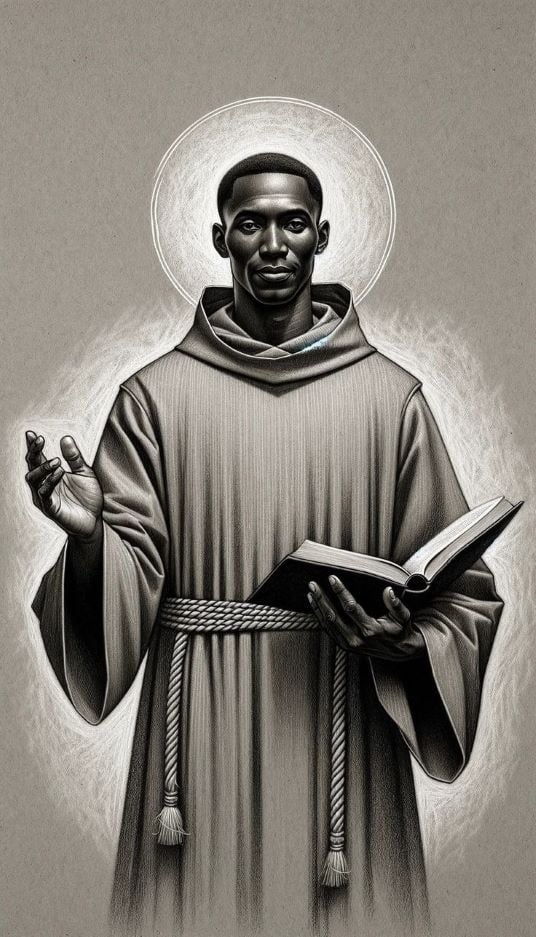
Our Patron Saint
-
Parish Enrollment
"Without a Vision, the People Perish”
Proverbs 29:18
 We invite you to join our parish for Worship and Community.
-
-
-
Pastoral Reflection: A Word from Fr. Matthew - Praying for the CityAugust 11, 2026
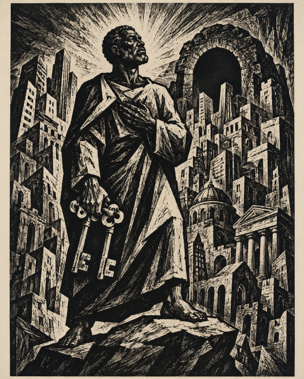
 James Lesesne Wells - 'Looking Upward' (1928). Source: National Gallery of Art/Looking Upward by James Lesesne WellsThis August, Pope Leo XIV asked the whole Church to pray for something that can sound almost too familiar to notice: evangelization in the city. It is easy to hear those words and move on — of course the Gospel belongs in the city; St. Benedict the Moor has been proclaiming it here for generations. But Pope Leo's intention names something sharper than a general reminder. He points to anonymity, noise, and isolation as the particular soil the Gospel must now take root in, because for the first time in human history, nearly half the world's people live in cities, and a great many of them live surrounded by others while knowing almost no one.
This is not a new concern for the Church, only a newly urgent one. Fifty years ago, Pope Paul VI insisted that the Gospel has to reach the roots of a culture, not just decorate its surface. Pope John Paul II went further, naming what many had been slow to admit: cities that were once thoroughly Christian had quietly become mission territory again, not because faith had been outlawed, but because it had been crowded out. Pope Francis asked us to find "other maps, other paradigms" for urban life — a plea to actually see the city as it is, rather than manage it defensively from a distance, as though ministry meant protecting ourselves from it.
I want to take this seriously, and I am asking you to take it seriously with me. We are an urban parish in an urban deanery. Anonymity, noise, and isolation are not abstractions for us; they describe real streets, real apartment buildings, real people who sit near us at Mass and go home to silence. Naming that is not despair — it is the first act of love, because we cannot accompany someone toward the light while pretending they are not in the dark.
So here is what I am asking of us. I am not going to let this pope's request pass with one homily and go quiet. In the months ahead, I will return to these questions in the bulletin, from the pulpit, and at our Pastoral Council meetings: Where do our people experience isolation, even inside a full church? What would it mean for St. Benedict the Moor to be a place where a stranger becomes known by name? How do we carry Christ into the noise rather than simply raising our voice above it?
I also want our parish organizations — the Christian Mothers among them — to take up these same questions in their own meetings, in their own way. You know corners of this parish and this neighborhood that I do not. Bring what you see back to me and to one another.
The city is not an obstacle to holiness. It is, right now, our mission field. Let us walk into it together, with eyes open and doors unlocked.
— Fr. Matthew
-
-
-
Sacrament of Reconciliation
- Sunday: 10:30 AM to 10:45 AM
Please call 412.281.3141 or email Fr. Matthew Hawkins at [email protected] for an appointment. -
Mission Proposal: We Want Your Ideas for Our ParishDear St. Benedict the Moor Family,

One of the great blessings of St. Benedict the Moor Parish is the depth of talent, experience, and faith our people carry. Many of you see needs in our community and already have ideas about how the parish might respond. That is the Holy Spirit at work, and I am genuinely grateful for it.
To honor that inspiration — and to be good stewards of the time, energy, and resources God has entrusted to us — I am inviting every member of this parish to participate in our ministry life in a new and more intentional way: the Mission Proposal.
-
Parish Information
-
Church & Parish Office
-
Bulletins
-
Flocknote
-
Online GivingIt is now easier than ever to support our parish through online giving. Please give online and watch our parish grow.
Click HERE to learn more about online giving or to enroll for recurring donations or make a one-time gift.
-
-
Sunday Readings
-
August 23Twenty-first Sunday in Ordinary Time
"I wait for the Lord; my soul waits for his word.” Psalm 130:5
First Reading: 1 Kings 19:9a, 11-13a
Responsorial Psalm 85:9, 10, 11-12, 13-14
Second Reading: Romans 9:1-5
The Gospel: Matthew 14:22-33
-
August 30Twenty-second Sunday in Ordinary Time
""May the Father of our Lord Jesus Christ enlighten the eyes of our hearts, that we may know what is the hope that belongs to our call.” cf. Ephesians 1:17-18
First Reading: Jeremiah 20:7-9
Responsorial Psalm 63:2, 3-4, 5-6, 8-9
Second Reading: Romans 12:1-2
The Gospel: Matthew 16:21-27
-
-
August 23, 2026
-
Series on the Eucharist: Sacrifice"This is my body, which is given for you." Luke 22:19
 "Sacrifice" is not a comfortable word anymore, even among believers. It sounds like loss, like something taken from us rather than something given. So we've quietly replaced it in our imagination with softer words — meal, gathering, memorial — each true as far as it goes, but each capable of hiding the hardest claim the Church makes about the Mass: that Calvary is not remembered here so much as made present. One sacrifice, offered once, made available again at this altar, today, for you.
That claim only makes sense if we let it be as costly as it actually is. Christ does not hold anything back at the Last Supper or on the cross — no self-protection, no reserve, no hedging. The whole of himself, given. And the Mass asks something of us in response that isn't merely attendance: it asks that we bring something of our own to lay beside his. Our week. Our failures. The thing we've been unwilling to surrender. The priest's silent gestures at the altar — the quiet moment over the gifts before the Eucharistic Prayer begins — aren't ornamental. They're the space where that offering is supposed to happen, where what's on the paten is not just bread but whatever we're finally willing to put there.
Most of us live guarded lives. We give what's convenient and keep the rest in reserve — our time, our forgiveness, our willingness to be inconvenienced by someone else's need. The Eucharist doesn't condemn that instinct so much as it interrupts it, week after week, by putting total self-gift directly in front of us and asking whether we recognize the difference between the two.
What have you actually offered at the altar lately — and what have you been holding back? Is there a grudge, a fear, a comfort you haven't been willing to place there? The invitation isn't guilt. It's an honest look at what self-gift would cost you, and whether you've been willing to pay it.
— Fr. Matthew HawkinsNext week: what happens when that offering is received — not privately, but together.
-
The Six Pillars: What Kind of Parish Are We Becoming?
 We began this series more than six weeks ago with a distinction: the difference between maintenance and mission. We end it with a question that belongs to all of us: What kind of parish is God calling St. Benedict the Moor to become?
Not what kind of parish have we been. Not what kind of parish are we comfortable being. What kind of parish is God calling us to become?
That question has an answer — or rather, it has six answers, one for each pillar we have explored in this series. And when you hold all six together, a picture emerges.
We are called to be a Eucharistic parish — one where everything flows from and returns to the Mass, where Christ's presence at the altar shapes how we understand presence in every other part of our life together.
We are called to be a culturally confident parish — one that honors the Black Catholic heritage entrusted to us not as a limitation on our mission, but as a gift we carry for the whole Church. Our history is not a burden. It is a charism.
We are called to be a hospitable parish — one where seekers, strangers, and people who have not yet found their way home to the Church encounter something real: not a performance of welcome, but an actual community that is glad they walked through the door.
We are called to be a charitable parish — one where service to neighbors in need is not an occasional gesture but a stable, consistent witness that makes the love of God visible in the Diocese of Pittsburgh.
We are called to be a pastorally responsible parish — one that cares for the whole person: mind, heart, soul, and yes, body. A parish where no one collapses in the pew without someone prepared to respond, and where chronic health disparities in our community are something we address rather than ignore.
And we are called to be a listening parish — one that takes seriously the wisdom of every person who walks through these doors, that gathers stories instead of only issuing announcements, and that trusts the Holy Spirit to speak through the ordinary lives of ordinary people.
Six pillars. One mission. Six years in.
It would be easy, at an anniversary, to celebrate what we have already done. And there is real reason to give thanks — for the community that has gathered here, for the faith that has been passed on, for the moments of grace that have happened in this space and through this people. We do not take any of that for granted.
But the greater gift of an anniversary is not backward-looking. It is the invitation to ask, with fresh eyes, where we are being called next. St. Benedict the Moor was established as a personal parish with a special mission to evangelize through inculturation because someone believed — and we believe it too — that the Gospel has something particular and powerful to say to Black Americans, and that Black Catholics have something particular and powerful to offer the whole Church. We have not exhausted that calling. We have barely begun it.
So we give thanks. And we recommit. And we walk forward together.
That is what a personal parish with a mission does.
— Fr. Matthew Hawkins, Pastor
St. Benedict the Moor Parish, Pittsburgh
-
-
News and Information
-
-
-
Events
-
Thursday, August 27, 7:00 PM - 8:30 PM

-
Read MoreSunday, August 30, 11:00 AM - 12:30 PM
-
Thursday, September 3, 7:00 PM - 8:30 PM
-
Read MoreSunday, September 6, 10:00 AM - 10:45 AM
-
Read MoreSunday, September 6, 11:00 AM - 12:30 PM
-
Read MoreTuesday, September 8, 7:00 PM - 8:30 PM
-
Thursday, September 10, 7:00 PM - 8:30 PM
- There are no upcoming events.
-
-
-
-
May 27, 2026What does it mean for a parish to know who it is and still open its doors wide to others? This article highlights St. Benedict the Moor Parish as a mission parish rooted in Black Catholic heritage, joyful worship, evangelization, and radical hospitality. It tells the story of a community whose identity is not narrowed by its history, but strengthened by it — a parish where Catholic faith, cultural memory, vibrant liturgy, and welcome come together as a gift for the whole Church.
Read the full article to learn how St. Benedict the Moor is living its mission as a parish that honors its past, embraces its diverse present, and forms disciples for the future.
-
-
-
Discover the beauty, truth, and wisdom by participating in weekly meetings with Fr. Matthew Hawkins on Thursdays at 7 pm on Zoom.
For more information, contact Fr. Matthew at 412.281.3141 or [email protected].
Registration is required for the Zoom link.
-
-
-
Catholics and the Church
- Newsroom (USCCB)
- Newsroom (USCCB)
- Catholic Diocese of Pittsburgh
- Pittsburgh Catholic Online
- Mass Times in the United States
- United States Conference of Catholic Bishops (USCCB)
- Catholic Current Podcasts (USCCB)
- The Vatican
- Catechism of the Catholic Church
- Catholic Encyclopedia
- National Catholic Reporter
- OSV News
- U.S. Catholic
-
-
-
Effective July 1, 2025, Saint Benedict the Moor Parish will become part of the newly formed Central Deanery, which consists of 10 neighboring parishes within the North Vicariate of the Diocese of Pittsburgh.
-
-
-
If you suspect that a child is being abused, call the 24-hour Child Abuse Hotline: at 800.932.0313 to report suspected abuse.
If a child is in imminent danger, call 911.
-
-
-
-
-
-
Pastoral Message: A Catholic Witness to Peace by Fr. Matthew HawkinsJune 29, 2025
 As followers of Jesus Christ, we are called to be peacemakers in a world too often torn by violence. From the earliest centuries of the Church, some Christians have discerned a vocation to conscientious objection—refusing to participate in war or violence because of the Gospel's command to love our enemies.
In recent years, the Ben Salmon, No Just War Registry for Conscientious Objectors has been established to help Catholics bear public witness to the Gospel of peace. Named for a Catholic who refused to fight in World War I and wrote a powerful critique of just war theory, the registry allows individuals—especially young people—to formally declare their commitment to Christian nonviolence. This can serve both as a spiritual testimony and, if ever needed, a legal aid in the event of a future military draft.
As pastor, I affirm the right of Catholics to conscientious objection, which is supported by both the Catechism of the Catholic Church and statements from the U.S. Bishops. While the Church has long taught the criteria for a just war, it also respects the right of the individual conscience formed in prayer and fidelity to Christ.
If you—or someone you love—wishes to learn more about conscientious objection or would like to register their beliefs in accordance with the Gospel call to peace, please contact the parish office. We will be glad to assist in this process, offer spiritual support, and help you discern your path with integrity and courage.
Let us continue to pray for peace, and for the grace to be instruments of God's mercy in our troubled world.
Fr. Matthew
-